Most Goals in Football History: Official Rankings and Records
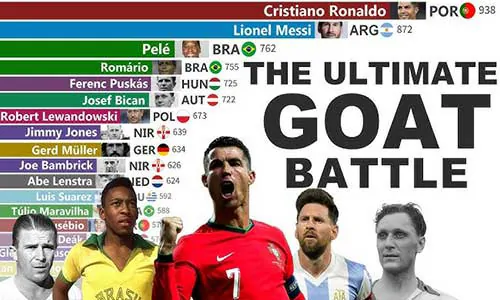
Football is a game defined by moments of pure magic, but ultimately, it is a sport ruled by numbers. Among all statistical milestones, none carries more weight, prestige, or romanticism than the ability to put the ball in the back of the net. For decades, fans, pundits, and historians have passionately debated who truly deserves the crown of the ultimate marksman. When debating the greatest of all time, fans and analysts constantly search for the definitive list of the Most Goals in Football History: Official Rankings and Records.
While modern superstars continue to rewrite the record books, historical icons have left legacies that remain shrouded in statistical mystery. Consequently, understanding how these goals are counted, archived, and verified is essential to appreciating the scale of their achievements. In this comprehensive guide, we will break down the official tallies, analyze the differences in recording methodologies, and explore the players who have etched their names into footballing immortality.
Table of Contents
- 1. The Historical Context and Verification Challenges
- 2. The Elite “500-Goal Club”: A Measure of Ultimate Greatness
- 3. Top 10 All-Time Goalscorers Analyzed
- 4. Comparing Modern Icons Under the Official Records
- 5. FIFA vs. RSSSF vs. IFFHS: Why Tallying Methods Differ
- 6. Frequently Asked Questions (FAQ)
- 7. Conclusion & Final Thoughts
The Historical Context of the Most Goals in Football History: Official Rankings and Records
Before the era of high-definition television and digital databases, tracking every single goal scored across multiple continents was an incredibly difficult task. For example, during the early to mid-20th century, many regional leagues, state championships, and military tournaments kept manual records that were easily lost, altered, or disputed. Consequently, historians have to dig through dusty archives to piece together the careers of early legends.
Furthermore, the structure of football itself was vastly different. In the 1930s and 1940s, national leagues were not as standardized as they are today. Many players competed in highly competitive regional leagues that acted as the top tier of football in their respective countries. For instance, in Brazil, state championships like the Campeonato Paulista held immense prestige, often exceeding national competitions in organization and quality during Pelé’s early years.
To establish a fair standard, modern statistical bodies have defined “official matches” as senior-level fixtures played in official leagues, national cups, continental club tournaments, and recognized international matches. Despite these guidelines, the debate surrounding the all-time scoring crown is as much about archiving history as it is about athletic performance. This makes analyzing the historical context a fascinating journey into the sport’s evolution.
The Elite “500-Goal Club”: A Measure of Ultimate Greatness
Reaching the 500-goal mark in official matches is a milestone so rare that only a select group of players have ever accomplished it. In the modern era, defensive tactics have become highly sophisticated, and sports science has optimized team structures to limit space. Nevertheless, exceptional talents still manage to break through these barriers and achieve astonishing numbers over long careers.
Several legendary figures have comfortably surpassed the 500-goal threshold but sit just outside the top tier of all-time scorers. Robert Lewandowski, for instance, has scored over 685 goals in official competitions, establishing himself as one of the most clinical strikers of the 21st century. Similarly, Luis Suárez has surpassed the 604-goal mark, proving his predatory instincts across the Eredivisie, Premier League, La Liga, and the international stage with Uruguay.
In contrast, historical stars like Ferenc Peyroteo achieved some of the most concentrated scoring rates ever recorded. Peyroteo scored an incredible 544 goals in just 334 matches for Sporting CP and Portugal, averaging over 1.6 goals per game. However, because his career was relatively short, he retired before he could climb higher up the absolute volume rankings, highlighting how longevity is just as important as peak efficiency.
The Top 10 All-Time Goalscorers: Most Goals in Football History: Official Rankings and Records Analyzed
To bring clarity to this legendary debate, we look at the official numbers verified by leading statistical bodies. Below is an in-depth analysis of the ten most prolific goalscorers in the history of association football, tracing their journeys from local prospects to global legends.
1. Cristiano Ronaldo (973 Goals)
When looking at the Most Goals in Football History: Official Rankings and Records, Cristiano Ronaldo stands at the absolute pinnacle of the sport. As of June 2026, the Portuguese phenomenon has amassed an astonishing 973 official career goals for club and country. His career began at Sporting CP, followed by legendary, trophy-laden stints at Manchester United, Real Madrid, Juventus, and Al Nassr.
Moreover, Ronaldo is the all-time leading goalscorer in men’s international football, having netted 145 goals for the Portuguese national team. His transition from a flamboyant winger to a clinical, hyper-efficient central striker is one of the greatest tactical evolutions in sports. His relentless physical conditioning and unmatched longevity have positioned him as the prime candidate to become the first player in history to reach the legendary 1,000-goal milestone.
2. Lionel Messi (913 Goals)
Directly trailing his eternal rival is Lionel Messi, who has registered 913 official career goals as of June 2026. The Argentine playmaker spent the vast majority of his career at FC Barcelona, where he scored a club-record 672 goals. After a brief period at Paris Saint-Germain, Messi moved to Inter Miami in Major League Soccer, where he continues to delight fans and expand his goalscoring legacy.
In addition to his sheer volume of goals, Messi holds the record for the most goals scored in a single calendar year, netting an unbelievable 91 goals in 2012. What makes Messi’s tally even more remarkable is his dual role as his team’s primary playmaker. He has accumulated over 350 career assists alongside his goals, representing arguably the most complete attacking output in the history of the sport.
3. Josef Bican (805+ Goals)
Historically, Josef Bican was long considered the benchmark for the Most Goals in Football History: Official Rankings and Records according to older archives. Playing between the 1930s and 1950s, the Austrian-Czech striker was a force of nature, primarily for Slavia Prague. He possessed incredible speed, reportedly running 100 meters in 10.8 seconds, and was equally lethal with both feet.
While FIFA officially credited him with 805 goals in official matches, the RSSSF’s strict top-tier verified list places his number at 743. However, other databases that include regional league goals and reserve fixtures place his total well over 950. Regardless of the exact statistical filter applied, Bican’s jaw-dropping goal-to-game ratio remains one of the highest ever recorded, cementing his status as an era-defining legend.
4. Romário (772 Goals)
The Brazilian maestro Romário is celebrated for his clinical finishing inside the penalty box. Officially, Romário scored 772 goals across a career that spanned over two decades, playing for clubs like Vasco da Gama, PSV Eindhoven, Barcelona, and the Brazilian national team, whom he famously led to World Cup glory in 1994.
Although Romário famously celebrated scoring his 1,000th goal in 2007, that milestone included goals scored in youth matches, friendlies, and testimonial games. Nevertheless, his official record of 772 goals is spectacular. His unique style, relying on short bursts of acceleration and toe-poke finishes, made him one of the most unpredictable and lethal strikers to ever play the game.
5. Pelé (762 Goals)
Perhaps no player’s goal tally has sparked more debate than Pelé’s. The three-time FIFA World Cup winner is widely regarded as one of the most influential figures in sporting history. Officially, Pelé scored 762 goals in competitive matches for Santos, the New York Cosmos, and the Brazilian national team.
However, Pelé and Santos claimed a total of 1,281 goals in 1,363 matches. This larger figure includes numerous friendly matches and international exhibition tours. While modern statisticians exclude these friendlies, historians point out that Santos’ tours of Europe in the 1960s were highly competitive, featuring matches against the best European clubs of the era. Therefore, while his official competitive tally stands at 762, his wider impact on the game remains immeasurable.
6. Ferenc Puskás (746 Goals)
The legendary Hungarian forward Ferenc Puskás was the spearhead of the famous “Mighty Magyars” national team of the 1950s and later a superstar for Real Madrid. Puskás scored 746 official goals in just 754 matches. His exceptional left foot, incredible vision, and tactical intelligence allowed him to maintain a near-perfect scoring record.
Puskás’ career was unique because he achieved world-class success in two distinct phases: first in Hungary with Budapest Honvéd, and then in Spain with Real Madrid after being exiled. His legacy is so profound that FIFA named its annual award for the most beautiful goal of the year after him, ensuring that his name remains synonymous with spectacular goalscoring.
7. Gerd Müller (735 Goals)
Known as “Der Bomber”, Gerd Müller is arguably the most clinical penalty-box striker in German football history. Müller scored 735 official goals for Bayern Munich and West Germany. His uncanny positioning, low center of gravity, and predatory instincts allowed him to score from almost any position inside the penalty area.
Müller’s goals were highly consequential; he scored the winning goal in the 1974 World Cup final and secured numerous domestic and European titles for Bayern Munich. Furthermore, Müller held the record for most Bundesliga goals (365) for decades, a testament to his unmatched consistency and dominance in one of Europe’s toughest leagues.
8. Ferenc Deák (576 Goals)
Another Hungarian prolific scorer, Ferenc Deák, played during the 1940s and scored at least 576 official goals. During the 1945–46 season, Deák scored an astonishing 66 goals in just 34 league appearances for Szentlőrinci AC. This remains one of the most dominant single-season league performances in European football history, showcasing the incredible attacking talent that emerged from Hungary during that golden era.
9. Uwe Seeler (575 Goals)
An icon of German football, Uwe Seeler was a powerful, versatile striker who spent almost his entire career with Hamburger SV. Seeler scored 575 official goals for club and country. His aerial ability, spectacular bicycle kicks, and work rate made him a beloved figure across Germany. He also represented West Germany in four consecutive World Cups, matching Pelé’s feat of scoring in four different tournaments.
10. Tulio Maravilha (575 Goals)
The journeyman Brazilian striker Tulio Maravilha claimed to have scored 1,000 goals during his career, though official records verify 575 goals. Tulio played for dozens of clubs worldwide, finding his greatest success with Botafogo. His colorful personality, sharp eye for goal, and longevity allowed him to play professionally well into his 40s, entertaining fans across Brazil.
All-Time Goalscoring Rankings Table
To help you visualize the all-time standings, the table below outlines the official statistics for the top 10 goalscorers in football history:
Note: While every effort is made to present the most accurate figures, historical tallies can slightly vary between statistical databases like RSSSF and IFFHS depending on the inclusion of certain regional and wartime matches.
Comparing Modern Icons Under the Most Goals in Football History: Official Rankings and Records
The rivalry between Cristiano Ronaldo and Lionel Messi has defined the 21st century of football, creating a golden era that fans may never witness again. Analyzing these statistics through the lens of the Most Goals in Football History: Official Rankings and Records reveals how much the modern game has evolved. Both players have maintained an unprecedented level of output for over two decades.
While Ronaldo’s goalscoring relies on supreme athletic longevity, explosive movement, and a lethal presence in the air, Messi’s goals often stem from intricate dribbling, direct free-kicks, and world-class playmaking. In contrast to historical goalscorers who often faced weaker regional defenses, both Ronaldo and Messi have scored the vast majority of their goals in the world’s most competitive arenas, such as La Liga, the Premier League, and the UEFA Champions League.
Consequently, their numbers are widely seen as the gold standard of modern football. As both players navigate the final chapters of their legendary careers, the race to see who will finish with the absolute most goals remains highly competitive. Currently, Ronaldo holds a significant lead, but Messi’s playmaking brilliance keeps him close behind, ensuring that the ultimate conclusion to this historic rivalry has yet to be written.
FIFA vs. RSSSF vs. IFFHS: Why Tallying Methods Differ
One of the biggest sources of confusion for fans is why different websites display different goal tallies for the same players. To understand this, we must examine the organizations responsible for archiving these historic achievements:
- FIFA (Fédération Internationale de Football Association): As the global governing body, FIFA occasionally publishes historical profiles but does not maintain a day-to-day public database for historical individual goals. When they do recognize records, they tend to lean on conservative, verified metrics. For more details on official regulations, you can visit the official FIFA Portal.
- RSSSF (Rec.Sport.Soccer Statistics Foundation): An international amateur organization that gathers deep historical data. RSSSF is incredibly thorough, often including goals scored in regional leagues, reserve teams, and even select friendly matches if they meet specific competitive criteria. For the ultimate statistical breakdown, check the RSSSF Database.
- IFFHS (International Federation of Football History & Statistics): This organization focuses strictly on “top-tier” football. They do not count goals scored in reserve teams, regional matches, or unofficial friendlies. Because of this standardized approach, their rankings are often considered the most reliable for comparing players across different eras.
In contrast to friendly matches, which are often played at half-speed, official matches carry intense competitive pressure. Therefore, modern consensus heavily prioritizes goal counts from official, senior-level club and international fixtures to ensure a fair comparison between eras.
Frequently Asked Questions (FAQ)
To help clarify any confusion regarding the Most Goals in Football History: Official Rankings and Records, we have compiled a list of the most common questions asked by fans and researchers:
Q1: Who has scored the most official goals in football history?
As of June 2026, Cristiano Ronaldo holds the official record for the most goals in football history, with 973 goals scored for club and country in competitive matches.
Q2: Did Pelé really score over 1,200 goals?
Yes, Pelé scored 1,281 goals in 1,363 matches. However, this figure includes friendly matches, military games, and unofficial exhibition tours. His official competitive goal count stands at 762.
Q3: Why do Josef Bican’s goal tallies differ between sources?
Josef Bican’s tallies differ because of varying database filters. FIFA historically recognized him with 805 goals, while the RSSSF’s strict top-level league criteria verifies 743 goals. Other databases that include reserve and youth matches place him over 950.
Q4: Who has scored the most goals for a single club?
Lionel Messi holds the record for the most goals scored for a single club, having scored an astonishing 672 goals for FC Barcelona between 2004 and 2021.
Q5: Who is the top international goalscorer in men’s football?
Cristiano Ronaldo is the top international goalscorer in men’s football, with 145 goals scored for the Portugal national team as of June 2026.
Q6: What qualifies as an ‘official’ goal in football rankings?
An official goal is one scored in a competitive match organized by a national association or international governing body. This includes domestic leagues, domestic cups, continental tournaments (like the UEFA Champions League), and senior international matches.
Conclusion & Final Thoughts
In conclusion, tracking the Most Goals in Football History: Official Rankings and Records highlights both the incredible evolution of football and the sheer greatness of its finest players. From the unverified archives of the early 20th century to the hyper-analyzed modern era of Cristiano Ronaldo and Lionel Messi, goalscoring remains the ultimate metric of footballing greatness.
While historical debates regarding Pelé’s friendlies or Josef Bican’s reserve goals will continue to spark passion, the official records provide a clear benchmark. Modern fans are privileged to witness a period where records that stood for over half a century are being broken in real-time by two generational talents.
Who do you believe is the greatest goalscorer of all time? Do you prioritize the astonishing ratios of the past or the relentless consistency of the modern era? Share this article with fellow football enthusiasts and let us know your thoughts in the comments below!