Football Position Numbers Explained: The Meaning of 1 to 11
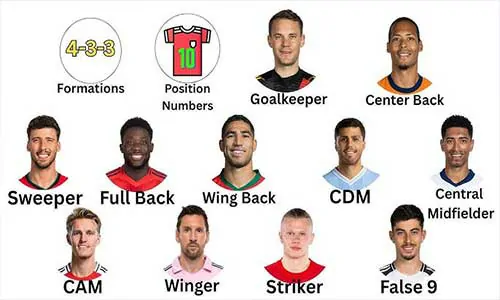
Table of Contents
- 1. Introduction to Football Squad Numbers
- 2. The History of Football Position Numbers Explained: The Meaning of 1 to 11
- 3. The Defensive Unit (Numbers 1 to 5)
- 4. The Midfield Engine Room (Numbers 6, 8, and 10)
- 5. The Attacking Force (Numbers 7, 9, and 11)
- 6. Modern Tactical Changes and Football Position Numbers Explained: The Meaning of 1 to 11
- 7. Quick Summary Table of Positions
- 8. Conclusion and Tactical Takeaways
- 9. Frequently Asked Questions (FAQ)
Every time you watch a football match, you see players running across the pitch with specific numbers on their backs. While squad numbers today are often chosen based on personal preference or commercial branding, they originally represented a strict tactical blueprint. Understanding these classic roles is key to fully appreciating the modern game.
In this comprehensive guide, we provide Football Position Numbers Explained: The Meaning of 1 to 11 to help you understand the historical, tactical, and functional significance of each number. Whether you are a beginner trying to learn the rules or an experienced fan decoding complex formations, knowing these positions will transform how you read the pitch.
Furthermore, while formations have changed, these numbers still define the roles commentators and coaches reference daily. Consequently, mastering this numerical language will elevate your football intelligence immediately.
The History of Football Position Numbers Explained: The Meaning of 1 to 11
To understand why specific numbers are assigned to certain positions, we must look back to the early 20th century. Football squad numbering was first trialed in England during the 1920s and famously used in the 1933 FA Cup Final between Everton and Manchester City. During this era, the standard team formation was the classic “2-3-5” system, also known as the “Pyramid” formation.
Consequently, the numbers 1 to 11 were handed out sequentially from back to front, right to left. The goalkeeper received number 1, followed by the two full-backs (numbers 2 and 3), the three half-backs (numbers 4, 5, and 6), and finally, the five forwards (numbers 7, 8, 9, 10, and 11).
Therefore, as formations evolved into the modern 4-4-2 or 4-3-3, the numbers shifted slightly but retained their core identity. Let us dive deeper into the classic breakdown of Football Position Numbers Explained: The Meaning of 1 to 11 and explore how each role functions today.
The Defensive Unit (Numbers 1 to 5)
Number 1: The Goalkeeper (GK)
Traditionally, the number 1 shirt is reserved exclusively for the starting goalkeeper. They are the ultimate line of defense and the only player permitted to handle the ball inside the penalty box. Analyzing the role of the goalkeeper is the first step in decoding Football Position Numbers Explained: The Meaning of 1 to 11.
In the past, their role was strictly limited to shot-stopping, throwing, and making long clearances. However, the modern goalkeeper has evolved into an active outfield contributor. Under contemporary tactical managers, they are expected to act as “sweeper-keepers,” playing out from the back and initiating team attacks with highly accurate distribution.
Number 2: The Right-Back (RB)
The number 2 is traditionally worn by the right-back, positioned on the right side of the defensive line. Their primary duty is to stop opposing left wingers from crossing, dribbling, or cutting inside. For the defensive line, understanding the right-back’s movement is key to Football Position Numbers Explained: The Meaning of 1 to 11.
Historically, this was a highly defensive position with little offensive responsibility. However, modern tactics require right-backs to be extremely versatile. Additionally, they must have the stamina to sprint up and down the wing, providing overlapping runs and delivering precise crosses into the opponent’s penalty box.
Number 3: The Left-Back (LB)
Mirroring the right-back, the number 3 is worn by the starting left-back. Their core responsibility involves defending the left flank against opposing right-sided attackers. Similarly, the left-back’s role remains vital to the broader system of Football Position Numbers Explained: The Meaning of 1 to 11.
To be effective, left-backs usually need to be naturally left-footed to easily deliver crosses. Over the years, legendary figures have shown how different styles can define this number, balancing impeccable defensive positioning with explosive attacking bursts to support the wingers.
Number 4: The Center-Back (CB)
The number 4 shirt is traditionally assigned to one of the central defenders, although in some continental systems, particularly in Spain and South America, it can refer to a defensive midfielder. In a standard European back four, the number 4 is a towering center-back. Indeed, the center-back positions are a cornerstone of Football Position Numbers Explained: The Meaning of 1 to 11.
Their primary job is to win aerial duels, block shots, and mark the opposition’s main striker. Furthermore, they need excellent communication skills to organize the defensive line and prevent defensive gaps from opening up.
Number 5: The Center-Back (CB)
Partnering with the number 4, the number 5 center-back completes the central defensive pairing. Traditionally, the number 5 was often seen as the “stopper” or the more aggressive of the two central defenders, while the other would read the game. Partnering with the number 4, the number 5 is central to understanding Football Position Numbers Explained: The Meaning of 1 to 11.
However, in modern football, both center-backs must be highly skilled at passing and playing out from the back. Consequently, they act as the initial point of possession, requiring high composure under pressure.
The Midfield Engine Room (Numbers 6, 8, and 10)
Number 6: The Defensive Midfielder (DM)
The number 6 represents the deep-lying defensive midfielder, often referred to as the “pivot” or “anchor.” Sitting just in front of the back four, this player acts as a shield to disrupt opposition counter-attacks. In midfield, the defensive pivot plays a crucial role within Football Position Numbers Explained: The Meaning of 1 to 11.
In addition to their defensive responsibilities, the number 6 is the heartbeat of a team’s build-up play. They receive the ball from the defenders and distribute it to more creative teammates. Consequently, they require exceptional spatial awareness and passing accuracy.
Number 8: The Central Midfielder (CM / Box-to-Box)
The number 8 is worn by the box-to-box central midfielder. This player must possess immense stamina, as they are expected to contribute equally in both defense and attack. As the engine room of the team, the central midfielder is a major element of Football Position Numbers Explained: The Meaning of 1 to 11.
They work tirelessly to win back possession in their own half and then sprint forward to support the strikers in the opponent’s box. Because of this dual responsibility, they require a complete skill set, including tackling, passing, and long-range shooting.
Number 10: The Attacking Midfielder / Playmaker (AM)
The number 10 is arguably the most sacred number in football, reserved for the team’s creative mastermind. Historically, the number 10 is the playmaker, operating in the “pocket of space” between the opposition’s midfield and defense. The playmaker or number 10 is perhaps the most romantic aspect of Football Position Numbers Explained: The Meaning of 1 to 11.
They possess extraordinary vision, dribbling skills, and passing accuracy, allowing them to unlock compact defenses with a single touch. Therefore, the number 10 represents artistic freedom, elite technical skill, and the ultimate creative spark on the pitch.
The Attacking Force (Numbers 7, 9, and 11)
Number 7: The Right Winger (RW)
The number 7 is one of the most iconic and glamorous shirts in football history. Traditionally worn by the right winger or right midfielder, this player is responsible for creating chances from the flank. The winger’s performance represents the wide threat in our guide to Football Position Numbers Explained: The Meaning of 1 to 11.
They use speed, dribbling ability, and precise crossing to break down opposing defenses. However, the role has evolved from a traditional wide midfielder to an inside forward who cuts inside to score goals, combining playmaking with clinical finishing.
Number 9: The Striker / Center Forward (ST)
The number 9 is the ultimate goalscorer’s shirt. Traditionally assigned to the central striker, this player’s main objective is to put the ball in the back of the net. The striker is often the central focus of any discussion regarding Football Position Numbers Explained: The Meaning of 1 to 11.
They usually operate in the opponent’s penalty area, using their physical strength to hold up the ball, their movement to lose defenders, and their clinical finishing to score. While the modern game has introduced fluid attacking concepts, the demand for a lethal, out-and-out number 9 remains incredibly high.
Number 11: The Left Winger (LW)
Completing the traditional line-up, the number 11 is worn by the left winger or left midfielder. Similar to the number 7, the number 11 is historically tasked with providing width, beating defenders on the outside, and delivering crosses. Finally, the left winger completes the classic list of Football Position Numbers Explained: The Meaning of 1 to 11.
In modern setups, we often see inverted wingers wearing the number 11, cutting inside onto their stronger right foot to shoot. This position remains a symbol of explosive pace, technical flair, and direct attacking threat.
Modern Tactical Changes and Football Position Numbers Explained: The Meaning of 1 to 11
Indeed, the modern game has seen a dramatic shift in how coaches implement Football Position Numbers Explained: The Meaning of 1 to 11. Historically, players were strictly bound to their numbered zones. However, contemporary tactics focus heavily on positional fluidity and space optimization.
Under visionary managers, players are expected to perform multiple roles within a single match. Consequently, knowing how these roles overlap is crucial for modern tactical analysis.
Tactical Evolution in Midfield: Football Position Numbers Explained: The Meaning of 1 to 11
For example, the classic number 6 is no longer just a physical destroyer. In modern systems, they must possess the technical skills of a playmaker, directing the tempo from deep areas. Similarly, the traditional central midfielder (number 8) is often expected to push high into the “half-spaces” to create overloads with wide players.
Furthermore, we have witnessed the rise of inverted full-backs who transition from their traditional wide defensive positions (numbers 2 and 3) into central midfield during possession. This hybrid role adds extra numbers to the midfield, completely altering the defensive structure.
Another profound shift is the rise of the “false 9”. This concept completely upends the traditional view of Football Position Numbers Explained: The Meaning of 1 to 11. Instead of staying high up the pitch to occupy the center-backs, a false 9 drops deep into midfield, drawing defenders out of position and creating space for inverted wingers to exploit.
Quick Summary Table of Positions
To help you visualize these positions and their evolutions, we have compiled a quick reference table outlining each squad number’s traditional role and modern equivalent.
| Number | Traditional Position | Key Responsibilities | Modern Adaptation |
|---|---|---|---|
| 1 | Goalkeeper | Shot-stopping and long clearances | Sweeper-keeper, initiating build-up play |
| 2 | Right-Back | Defending the right flank | Overlapping wing-back or inverted midfielder |
| 3 | Left-Back | Defending the left flank | Attacking crossing outlet or defensive third CB |
| 4 | Center-Back | Areal dominance, physical tackling | Ball-playing defender, building from back |
| 5 | Center-Back | Aggressive stopper / covering | Highly technical, tactically flexible defender |
| 6 | Defensive Midfielder | Shielding defense, tough tackling | Deep-lying playmaker, tempo dictator |
| 7 | Right Winger | Hugging the touchline, crossing | Inverted forward, goalscoring focal point |
| 8 | Central Midfielder | Box-to-box engine, tackling & shooting | Half-space creator, pressing specialist |
| 9 | Center Forward | Target man, penalty box finisher | False 9, press leader, link-up expert |
| 10 | Attacking Midfielder | Classic playmaker, feeding striker | Free-roaming creator, high press trigger |
| 11 | Left Winger | Wide dribbler, crossing from left | Goal-oriented inside forward |
Conclusion and Tactical Takeaways
In conclusion, having Football Position Numbers Explained: The Meaning of 1 to 11 gives you a deep appreciation of the sport’s tactical history. Modern squads may use higher shirt numbers for marketing, branding, or personal attachment, but the essence of the classic 1-11 blueprint remains deeply embedded in the language of the game.
When a commentator calls a player a “classic number 9” or a “creative number 10,” they are drawing from a rich century-old tradition. By understanding Football Position Numbers Explained: The Meaning of 1 to 11, you can watch any game with a more analytical eye, noticing the subtle movements, positional rotations, and tactical adaptations that define modern football.
What is your favorite football number and position? Do you prefer the traditional roles or the modern fluid interpretations? Let us know in the comments below, and share this guide with fellow football fans!
For more official rules and tactical guidelines, you can visit the official IFAB (International Football Association Board) website or check the latest global football developments on FIFA.
Frequently Asked Questions (FAQ)
To help clarify any remaining doubts, here are the most frequently asked questions about Football Position Numbers Explained: The Meaning of 1 to 11.
1. Why do football players wear specific numbers?
Originally, squad numbers from 1 to 11 were used to specify positions on the pitch. Today, while squad numbering is highly flexible, players often choose numbers that correspond to their traditional positions to honor the heritage of that specific role.
2. What does a “False 9” mean in football?
A “False 9” is an unconventional striker who, instead of playing close to the opposition’s defensive line, drops deep into the midfield space. This draws central defenders out of position, creating huge gaps for wingers or attacking midfielders to run into and score.
3. What is the difference between a Number 6 and a Number 8?
The main difference lies in their positioning and defensive responsibilities. A number 6 is a defensive midfielder who sits deep, protects the backline, and acts as a passing anchor. On the other hand, a number 8 is a box-to-box midfielder who works dynamically across the entire pitch, contributing equally to both attack and defense.
4. Why is the number 10 shirt so famous in football?
The number 10 shirt is legendary because it has traditionally been worn by the team’s most creative and technically gifted playmaker. Icons like Pelé, Diego Maradona, and Lionel Messi have worn this number, cementing its reputation as a symbol of footballing genius.
5. Can a goalkeeper wear a number other than 1?
Yes, in modern professional football, players can choose almost any squad number permitted by league regulations. However, the first-choice goalkeeper almost always claims the traditional number 1 shirt, while backup keepers often take numbers like 12, 13, or 25.
6. Why do some modern players wear very high numbers?
Many modern players choose high numbers due to personal significance, the year they were born, or because their favorite traditional number was already taken. Additionally, some academy players keep the high numbers they were assigned when they first graduated to the senior squad.